
Originally published on June 23, 2026 | Last updated on June 27, 2026
Affiliate Disclosure
This post contains some affiliate links. If you purchase through these links, Dog Dad may earn a small commission at no extra cost to you. All recommendations are based on genuine research and, where possible, personal experience with Mabel. We only recommend products we genuinely believe in.
Summer in the UK is brilliant. Longer evenings, beach trips, garden BBQs, and best of all, more time outside with your dog. But with warmer weather comes a very real risk: dogs can overheat fast, and heat-related illness is one of the most common summer emergencies vets see in the UK.
Whether it is a 30-degree heatwave or just a muggy day in July, knowing how to keep dogs cool in summer could genuinely save their life. And if you have got a stocky breed like a Staffy cross, a flat-faced dog, or a chunky older pup, you need to be extra switched on.
One thing that surprises me every summer is how many people I still see walking their dogs in the hottest part of the day.
Research by the Post Office found that over three in five (62%) dog owners surveyed said they would walk their dogs in temperatures over 20 degrees Celsius, even though that is when overheating becomes a real danger for many breeds.
I understand it, life is busy and routines are hard to shift, but on a warm July afternoon you will regularly see dogs being walked on sun-baked pavements at 2pm, tongues dragging, paws burning. It is one of those things that once you know the risks, you cannot unsee it. This guide covers everything you need to know to make sure your dog stays safe, comfortable and happy all summer long.
🐾 Mabel’s Story
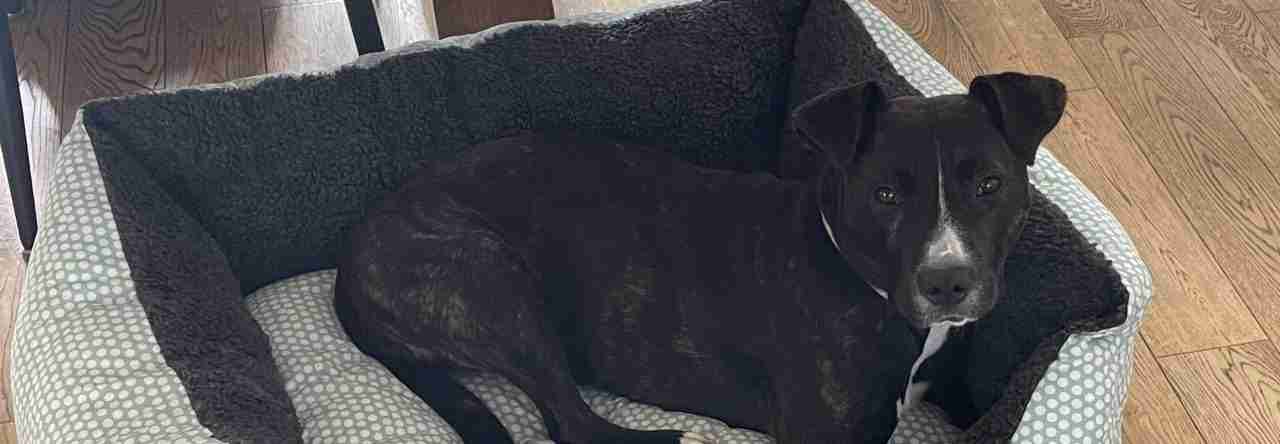
Our first summer with Mabel was a bit of a wake-up call. She is not like most dogs when it comes to summer cooling options, because she point blank refuses most of them. She does not like water. She discovered the sea for the first time at Hornsea and was absolutely horrified by it.
We tried a paddling pool and she treated it exclusively as a giant drinking bowl, zero interest in actually standing in it. We ran a sprinkler in the garden once and she went through it at full speed, gave us a look of absolute betrayal, and has avoided it ever since.
So while other dog owners have a toolkit of cooling options available, we basically have to be extra vigilant about her temperature because the usual methods simply do not apply to Mabel. It makes walk timing, shade, and cool indoor spaces even more important for us.
| Quick Disclaimer This post is for general guidance only. Always consult your vet if you are concerned about your dog’s health or suspect heatstroke. In an emergency, call your vet immediately. |
At a Glance: Top Picks for Keeping Your Dog Cool
Here is a quick overview of the best cooling methods and products to keep your dogs cool in summer in, all tested or vetted with Mabel in mind.
| Method / Product | Best For | Effort Level | Cost |
|---|---|---|---|
| Bush Digitel Grey Tower fans (x2) | Indoor cool room / any dog | Low | GBP 55 each (Argos) |
| Pup Ice Rocket Lollies | A ready-made frozen treat dogs go wild for | Low | £7.95 Amazon £2.50 Sainsburys |
| Frozen licki mat with squirty cream | Mental stimulation and cooling in one | Low | Amazon £4.99 |
| Frozen meals | Dogs who need longer enrichment | Low | Free if you feed wet food |
| Portable water bottle | Walks and days out | Low | £8.49 |
Why Do Dogs Struggle in the Heat?
Before we get into the tips, it helps to understand why dogs overheat more quickly than we do. The short version: they are not built to deal with heat the way humans are.
- Dogs cannot sweat through their skin. Their only real sweat glands are in their paw pads (which are often on hot pavements that have been baking in the sun).
- They rely almost entirely on panting to cool down. Panting is far less efficient than sweating, especially in humid conditions.
- Their body temperature is naturally higher than ours (around 38-39 degrees Celsius).
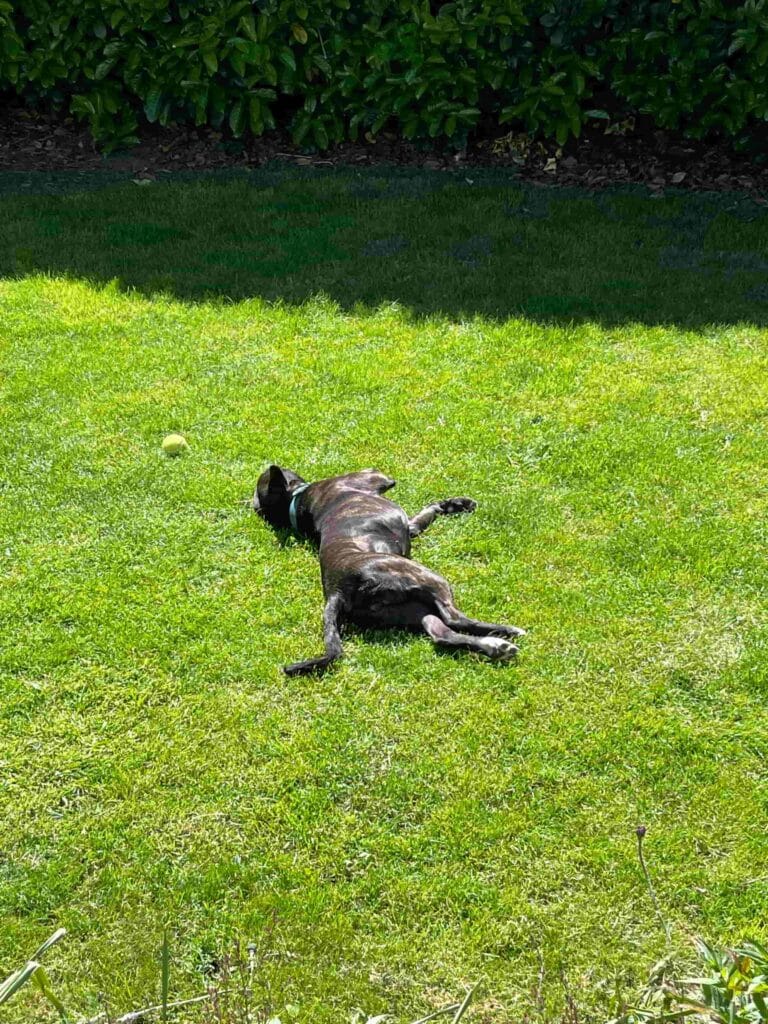
- Some dogs will push through the heat and keep playing even when they should stop. They do not always self-regulate. (Mabel does this, she wants to continue playing regardless of how warm she is.)
Research from the Royal Veterinary College in 2020 found that nearly 75% of heat-related illness cases in UK dogs were linked to exercise. And perhaps most alarmingly, a significant number of dogs were diagnosed with heatstroke when the temperature was only 16.9 degrees Celsius. You do not have to wait for a heatwave to take this seriously.
Which Dogs Are Most at Risk?
| Risk Factor | Why It Matters |
|---|---|
| Brachycephalic (flat-faced) breeds: Pugs, French Bulldogs, English Bulldogs | Restricted airways make panting less effective |
| Staffies and Staffy crosses | Muscular, energetic and often heat-enthusiastic, will push through discomfort |
| Older dogs | Reduced ability to regulate body temperature |
| Overweight dogs | Extra insulation traps heat |
| Puppies | Temperature regulation not fully developed |
| Thick or double-coated breeds: Huskies, Border Collies, Labradors | Heavy coats trap heat |
| Dogs with heart or respiratory conditions | Reduced cooling capacity |
1. When is best to walk your dog in hot weather
Walk timing is one of the most important decisions you make for how to keep your dog cool in summer. Most of the advice you will read says early morning or late evening, and that is genuinely good guidance. But that isn’t very specific or helpful.
The golden rule for walking your dog in summer or hot weather: Before 8am or after 7pm
On warm days in the UK, the safest windows to walk your dog are:
- Early morning (before 8am): air is cooler and cars/pavements have not had a chance to heat up
- Evening (after 7pm in summer): temperatures have dropped and the sun is lower
On particularly hot days (above 25 degrees Celsius), consider skipping the walk altogether and doing enrichment indoors instead.
The golden rule for walking your dog in a heatwave: Before 7am or after 8pm
During the UK heatwave on 25th May and week commencing June 22nd where temperatures I was up at 6am to feed and walk Mabel at Cromwell Bottom Nature Reserve for 30 – 45 minutes , knowing there was simply no way I would be able to walk her safely later in the day. It was absolutely worth losing the lie-in.
Always check the weather and the humidity
Before heading out, do not just check the temperature. Check the humidity level too. It might show 20 degrees Celsius on your weather app, but if the humidity is high, it can feel significantly warmer than that, closer to 25 degrees in practice. Your dog will feel that difference even if the thermometer does not show it.
Panting works by evaporating moisture, but in humid conditions there is already so much moisture in the air that the process becomes much less effective. A 20-degree humid day can be more dangerous for your dog than a dry 23-degree day.
- Use the BBC Weather app or Met Office app to check both temperature and humidity before walks
- If the feels-like temperature is above your target threshold, treat it the same as if the actual temperature were that high
- High humidity plus a warm temperature is a red flag, not a green light
The 5-Second pavement test
Hot tarmac is one of the biggest hidden summer hazards. Dogs’ paw pads can blister and burn on hot surfaces, and it can happen quickly.
| How to do the 5-second pavement test Place the back of your hand flat on the pavement. Hold it there for 5 seconds. If it is uncomfortable or too hot for you, it is too hot for your dog’s paws. Simple as that. |
Signs that your dog’s paws have been burned include:
- Limping or refusing to walk
- Licking or chewing at their paws
- Pads that look darker, blistered, or red
- Missing sections of pad
🐾 Mabel’s Story
I once noticed Mabel consistently standing with only 3 paws on the ground at once, swapping which one was up every few seconds. I thought it was unusual behaviour until it clicked: the pavement was really hot and she was trying to give each paw a rest from the surface. I started doing the pavement test after that and now I do it every single time it is warm before we head out. Her paws, her rules.
Should you still walk your dog in hot weather?
Yes, but adapt the type and timing. Dogs still need mental and physical stimulation, but a high-energy run in midday sun is a no. Some good warm-weather alternatives include:
- Short, slow sniff walks in shady woodland or on grass (avoid tarmac entirely)
- Garden hose sessions or water play in the garden for dogs that enjoy it
- Frozen Kongs, snuffle mats, enrichment games indoors, frozen licki mats with squirty cream, and frozen meals (see the frozen treats section below for more ideas)
- Basic training sessions in a cool room
- Gentle swimming at a dog-friendly spot (keep an eye on them though)
| Temperature (Celsius) | Action |
|---|---|
| Below 20C | Normal walks fine for most dogs |
| 20-25C | Shorten walks, stick to shade, carry water, avoid midday. Check humidity. |
| 25-28C | Early morning or late evening only, avoid strenuous play |
| Above 28C | Minimal outdoor time, enrichment indoors, water play in the garden if your dog enjoys it |
| Heatwave (30C+) | Avoid outdoor walks entirely for most dogs |
2. How to keep your dog hydrated
Fresh water is the single most important thing you can provide for your dog in the heat. Dehydration sneaks up quickly, especially in active dogs.
Water Tips That Actually Work
- Put out multiple water bowls around the house and garden: we have 2 water bowls set up in the cool room for Mabel so she always has access
- Add ice cubes to keep the water cool for longer. I keep 2 of these ice cube trays on rotation in the freezer so one is always ready to use. You can also buy a large 1kg bag of ice cubes to keep in the freezer if you want a no-faff option.
- Change the water regularly: warm, stale water puts dogs off drinking
- Bring a portable water bottle and collapsible bowl on every walk
Some dogs will naturally drink more in the heat. Others, especially anxious or picky dogs, may need encouragement. Adding a splash of low-sodium dog-safe bone broth to their water can help entice them to drink more. It does not always have to be water either: after a walk if Mabel has been particularly good, we will sometimes give her a little milk as a reward and hydration boost. She absolutely loves it.
If your dog is really panting and not wanting to drink, sometimes you have to meet them where they are. We have had to cup water in our hand and bring it right to Mabel’s mouth 2 or 3 times before she will go to the bowl herself. A bit undignified for all involved, but it works.
🐾 Mabel’s Story
Mabel has some very specific thoughts on where she likes to drink. We have a mop bucket outside in the garden that collects rainwater, and for reasons known only to her, that is her favourite drinking spot. Completely ignores the fresh bowl we put out, goes straight for the slightly murky mop bucket. Dogs.
3. How to keep a dog cool inside the house by using shutting curtains, opening windows/doors and putting up bed sheets
If your dog has nowhere cool to retreat to, all the water in the world will not help. Providing shade and good airflow is essential.
Morning Ventilation: Let the Cool Air In First
One of the most effective tricks for keeping your house cool through the day costs nothing. On a hot day, get the doors and windows open early in the morning before the temperature rises, then close everything up once it starts to heat up.
My routine on hot WFH days is :-
- Walk Mabel early before 7AM
- Come home and give Mabel some milk
- Open the french doors and all the windows downstairs until 10AM
- Bring down our 2 tower fans and set them up in the living room
- Close all the doors/windows, shut the blinds/curtains and hang up sheets in the kitchen
The sun is facing the other side of the house at that point, so those rooms stay genuinely cool. Once the temperature starts climbing and the sun swings round, everything gets closed: curtains drawn, blinds down, bed sheet up over the glass kitchen doors to stop the sun pouring straight through. It makes a real difference to how cool the house stays for the rest of the day.
Tip: Put up a bed sheet or blackout curtain over large glass doors on the inside. It is not glamorous but it dramatically reduces heat coming through on sunny mornings.

How to keep dogs cool by creating a dog cool room
The single best thing you can do on a hot day is designate one room in the house as a cool room for your dog. Pick the room with the least sun exposure (usually north-facing), then set it up properly:
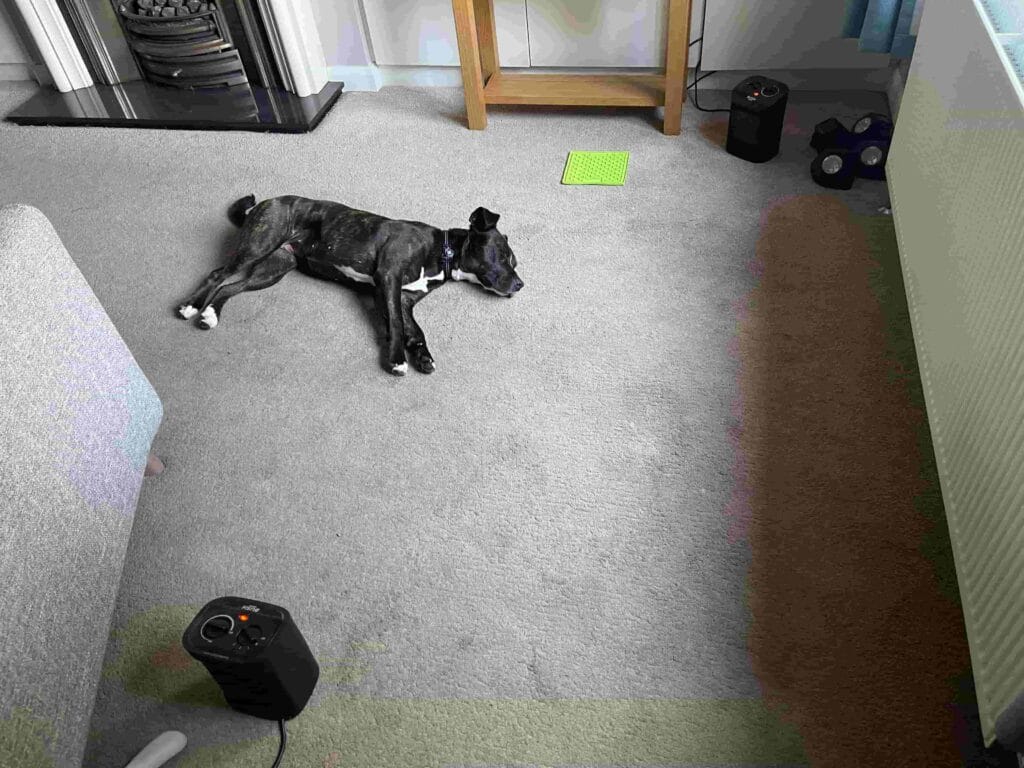
- Position two tower fans at angles so air circulates around the room rather than blowing in a single direction
- Set up two water bowls so there is always water within easy reach
- Close the curtains or blinds before the hottest part of the day (usually between 10:00 and 11:00) south-facing rooms heat up fast
- Give your dog access to tiled floors, which stay naturally cool
- Leave the door open so they can move freely in and out as they choose
Having two fans running in the same space makes a noticeable difference compared to one. You are creating proper cross-circulation of air rather than just a single point of breeze. If you work from home, moving into the cool room yourself on hot days serves double duty: it keeps you comfortable and keeps your dog company while they cool down.
During heatwaves we also try to limit how much cooking we do in the kitchen. Using the oven on a hot day is essentially running an extra radiator. We tend to switch to the air fryer or microwave during heatwaves to avoid heating the kitchen up any further, which makes a noticeable difference to the room temperature.
In the Garden
- Provide a shaded area: we have a large parasol in the garden for exactly this reason. Mabel has shown exactly zero interest in sitting under it (she prefers to bake in direct sunlight), but it is there if she ever changes her mind, and it means we can sit outside comfortably with her.
- Avoid leaving dogs outside in direct sun without supervision
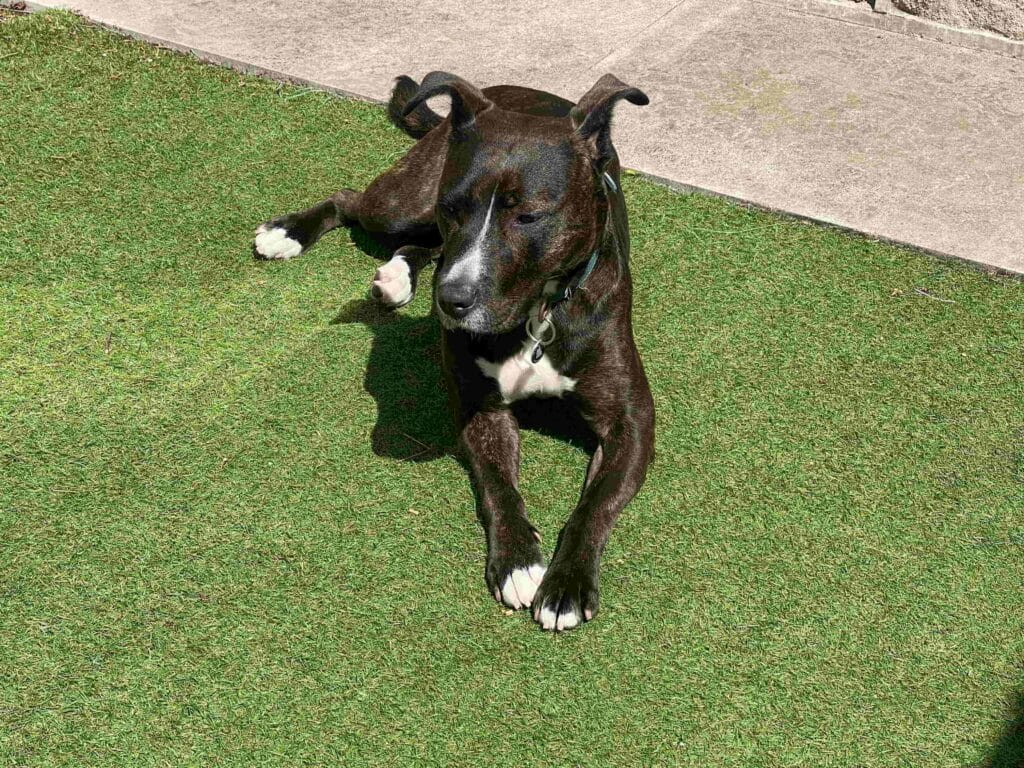
- Be careful with artificial grass. Unlike natural grass, artificial turf has no moisture content, so it does not cool down the same way. On a hot day it can get significantly hotter than the surrounding ground. We do not let Mabel walk on ours during summer: it is too hot underfoot and there is no benefit to her being on it.
- Sprinklers and water toys are great for dogs that like a splash
| Important: Never place a damp towel over your dog. It traps heat rather than releasing it. A damp towel underneath them is fine, but never over the top. |
4. Use the best cooling products for dogs (UK picks)
Getting the right kit makes a genuine difference during a UK heatwave. Below is an honest breakdown of what actually works, based on what we use with Mabel. ( There are no recommendations for paddling pools, water fountains, cooling mats or cooling clothing, as Mabel does not like them.)
Tower fans
Tower fans are one of the most practical and affordable ways to create a cool space for your dog indoors. Unlike desk fans, tower fans circulate air across the full height of the room, which means your dog benefits even when they are lying flat on the floor.
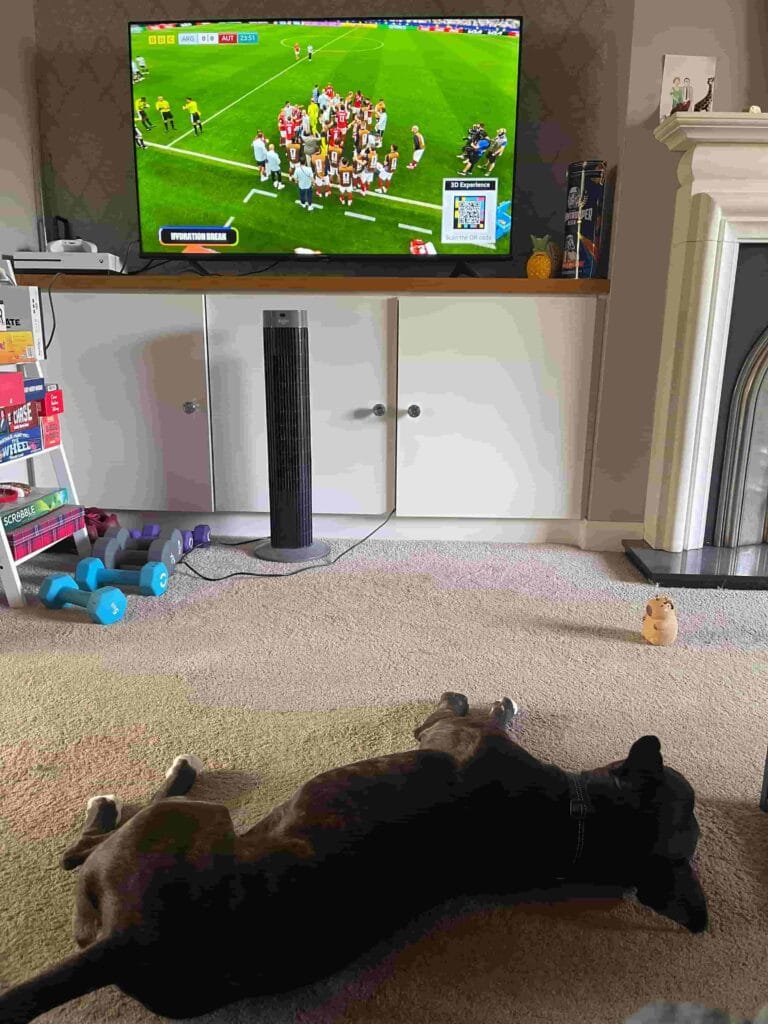
We use two Bush digital grey tower fans to create what we call Mabel’s Cool Room during hot weather. Running two fans in the same space makes a noticeable difference compared to one, creating proper airflow rather than just a single point of breeze.
🐾 Mabel’s Story
Mabel is a sun worshipper through and through. When she was younger, we had to physically bring her back inside after 5-10 minutes in the garden because she would happily roast in direct sunlight and show zero interest in coming in on her own. She is a bit better about self-regulating now she is older, but the cool room with her two fans has become her go-to once she has had her sun fix and actually starts to feel the heat. She tends to settle in one of two spots: either on the sofa with a fan about 2 metres in front of her, or in the middle of the room positioned between the two fans near the door. We keep the fans on medium though: she is not keen on the higher speed setting, it is a bit too powerful for her liking. On high it ruffles her and she is not impressed. Medium is the sweet spot.
Bush Digital Grey Tower Fan: Our Pick
Best for: Dog owners who want to create a dedicated cool room without spending a fortune. Works brilliantly as a pair.
Price: GBP 55 from Argos (product 731/5884)
The Bush Digital Grey Tower Fan is a solid, no-nonsense tower fan that punches above its price point. It stands 76.5cm tall, oscillates to move air around the room, and comes with a remote control so you can adjust settings without getting up. There are three speed settings plus variable speed control, and it costs just 1p per hour to run at current energy prices: which means leaving it on all day for your dog is not going to break the bank.
| Height | Speeds | Remote | Running Cost |
|---|---|---|---|
| 76.5cm | 3 + variable | Yes, included | 1p per hour |
| Pros | Cons |
|---|---|
| + Affordable at GBP 55: sensible to buy two | – Can be loud on the highest speed setting |
| + Remote control means no getting up to adjust | – No cooling function: moves air rather than chilling it |
| + Oscillation circulates air across the whole room | – Display panel cannot be dimmed for dark rooms |
| + Only 1p per hour to run: cheap enough to leave on all day | – Best results come from using two: adds up to GBP 110 |
| + Tall enough to move air above floor level where your dog lies | |
| + Quiet on lower settings: suitable for overnight use | |
| + Easy to assemble and minimal footprint |
Dog Dad Tip: Run Two, Not One A single fan moves air in one direction. Two fans positioned at angles in the same room create proper cross-circulation, which is noticeably more effective. We position Mabel’s two fans so the airflow meets roughly where she likes to lie. Keep them on medium: the high setting can be overwhelming for dogs and Mabel will vote with her paws and leave the room. |
5. Freeze meals, treats & vegetables to keep your dog cool and add enrichment
Frozen treats are an excellent way to cool your dog from the inside out while keeping them entertained on a hot afternoon. They are especially useful for dogs that need stimulation when you cannot take them for a walk.
Easy Frozen Treat Ideas
- Frozen Kong: fill with peanut butter (xylitol-free), wet food, or banana, then freeze overnight
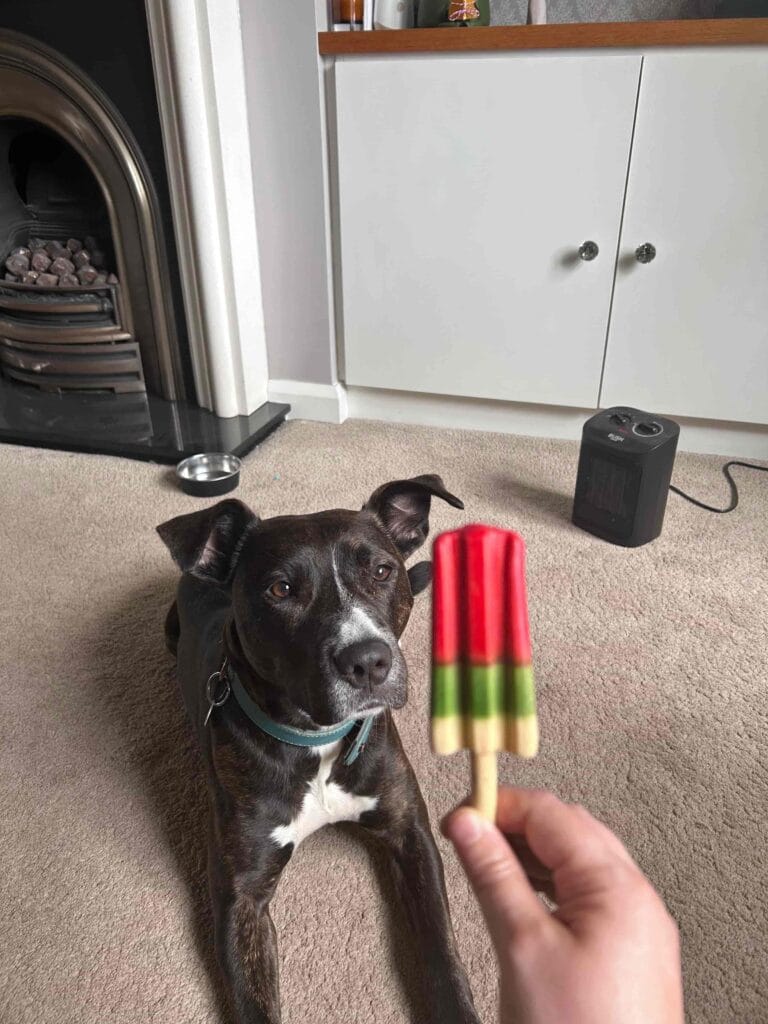
- Pup Ice Rocket Lollies: ready-made frozen lollies that you put in the freezer at home for 3 hours (full details below)
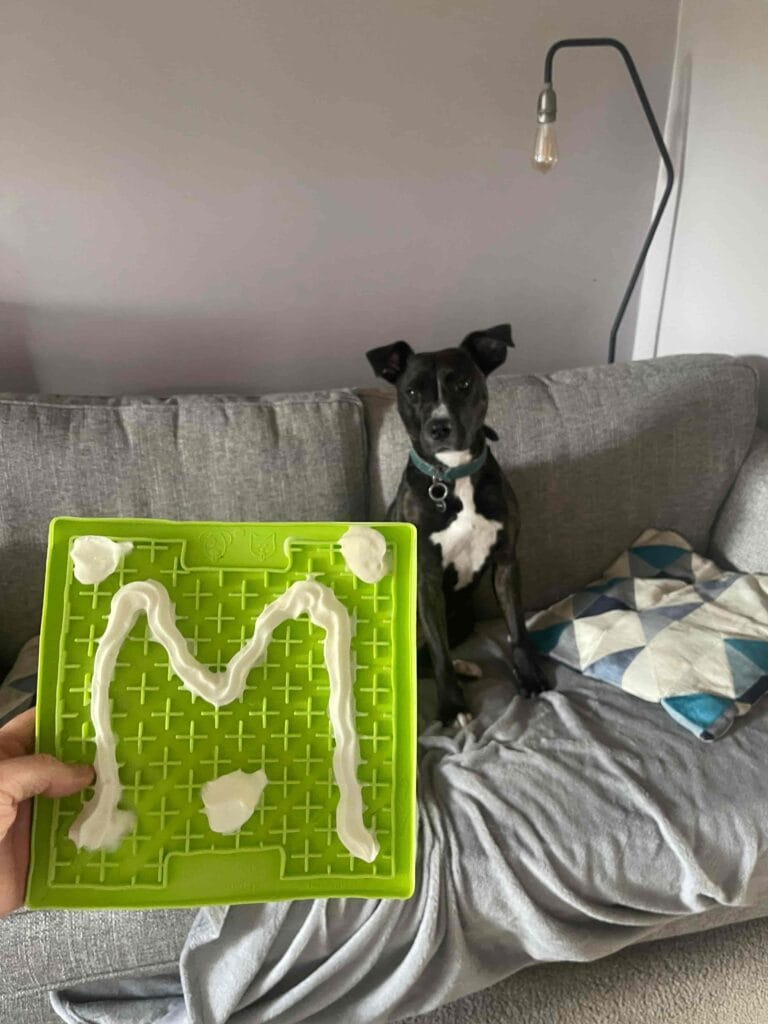
- Frozen licki mat with squirty cream: spread generously, freeze flat, and hand over. Dogs go absolutely mental for it
- Freeze your dog’s regular meals: this makes them last longer, adds enrichment and helps keep your dog hydrated as the food slowly thaws
- Ice cube treats: freeze dog-safe ingredients like chopped chicken, blueberries, or cucumber in water or diluted low-sodium broth
- Frozen carrot sticks: a natural chew that cools them down and is great for teeth.
- Doggy ice cream: wow watermelon flavoured so they can have their ice cream whilst you demolish a magnum
- Frozen vegetables: green beans, carrots, broccoli, cauliflower, cucumber, or peppers all make excellent additions to frozen meals or as standalone treats
| Foods to Avoid in Dog Treats Never use anything containing xylitol (an artificial sweetener found in some peanut butters), grapes, raisins, onion, or chocolate. When in doubt, check with your vet before introducing a new food. |
🐾 Mabel’s Story
Mabel has a deep and personal relationship with her frozen licki mat. We spread squirty cream on it and freeze it, and when we bring it out on a hot afternoon it is like we have handed her the Holy Grail. She goes absolutely to town on it. The frozen meals trick is also one we swear by: freezing her regular food means it takes her much longer to eat, keeps her cool from the inside, and keeps her entertained on days when we cannot get out for a proper walk. The addition of a few frozen veg pieces mixed in has been a hit too. She particularly loves frozen green beans and crunches through them like they are the greatest thing ever invented.
Pup Ice Rocket Lollies: Our Frozen Treat Pick
Best for: Dog owners who want a proper ready-made frozen treat that is genuinely different to anything else on the market.
Price: GBP 5.00 for a pack of 3 from Sainsbury’s
Where to buy: Amazon (Strawberry and Blueberry, 225g, medium breeds)
Pup Ice Rocket Lollies are unlike any other frozen dog treat you will find in the UK. They are solid chews rather than liquid-based, which means they do not melt, do not drip, and your dog’s tongue will not stick to them the way it might with a conventional ice treat. The rocket shape is obviously brilliant.
The process is simple: take them home, put the bag in the freezer for at least 3 hours, then hand one over. No moulds to fill, no prep, no mess. The lollies are made with chicken, strawberry and blueberry, and are enriched with calcium for healthy bones and teeth and prebiotics to support digestion. No added sugar and no artificial colours or flavours.
Each pack contains 3 lollies, sized for medium breeds. The whole lolly is edible including the stick, so there is nothing to monitor or take away.
| Pack Size | Flavour | Suitable For | Key Ingredients | Where to Buy |
|---|---|---|---|---|
| 225g (3 lollies) | Strawberry & Blueberry | Medium breeds, adult dogs | Chicken, strawberry, blueberry, calcium, prebiotics | Sainsbury’s |
| Pros | Cons |
|---|---|
| + No prep: just freeze and serve | – More expensive than homemade frozen treats per serving |
| + Mess-free solid chew that does not melt or drip | – Pack only contains 3 lollies |
| + Tongue-safe formula: no sticking like conventional ice | – Sized for medium breeds: smaller or larger dogs may need a different size |
| + Enriched with calcium and prebiotics | – Only available in limited flavours at Sainsbury’s currently |
| + No added sugar, no artificial colours or flavours | |
| + Whole treat is edible including the stick | |
| + No freezer needed for storage until ready to use |
6. Keeping Your Dog Cool in the Car
Even on a warm day, a parked car can heat up to dangerous temperatures within minutes. The car acts like a greenhouse, trapping heat far more effectively than the open air outside. According to the Royal Kennel Club, temperatures inside a car on a warm day can be much higher than outside, even with a window cracked.
🐾 Mabel’s Story
The main car we use for Mabel is a 10-year-old Ford Fiesta, parked on the drive at the front of the house and in full sun for most of the day. If the park is only 5 minutes away, I will drive with all the windows fully open & air con on, but I genuinely would not go any further than that in warm weather. If I ever needed to travel further with her on a hot day, I would move the car into shade at least a few hours before we needed to go, then open all the doors and windows for 5 minutes before she gets in to let the heat out. It is one of those things where the extra planning is absolutely worth it.
Tips for Keeping Your Dog Safe and Cool in the Car
- Never leave your dog alone in a parked car, not even for a few minutes
- Drive with the windows open or air conditioning on at all times when your dog is in the car
- If you have to travel further on a hot day, move the car into shade at least a couple of hours beforehand
- Open all doors and windows for 5 minutes before putting your dog in the car to let trapped hot air escape
- Use window sunshades to reflect the sun’s rays and keep the car cooler during the journey
- Travel with cool water in a thermos or insulated bottle and offer your dog a drink at every stop
- Make regular stops on longer journeys to let your dog stretch, drink, and cool down
- Avoid travelling during the hottest part of the day (typically 11am to 3pm in summer)
- Make sure your dog has a safe, well-ventilated spot in the car. A crate or boot area with good airflow is better than being wedged onto a back seat
- If using public transport, check in advance that it is air conditioned before travelling on a hot day
| The Rule Is Simple: If you cannot take your dog with you wherever you are going, do not take them in the car. Leave them somewhere cool at home rather than risk them waiting in a hot vehicle. |
What to Do If You See a Dog in a Hot Car
- In England and Wales: call 999 and ask for the police
- In Scotland: call 999 and also the SPCA on 0300 099 9999
- Stay with the dog and monitor their condition until help arrives
- If the dog is clearly in distress and help is not coming, the police have confirmed members of the public can break a window as a last resort: take photos first and act as a witness
Frequently Asked Questions
How do I know if my dog is too hot?
The key signs are heavy panting that does not calm down after resting, excessive drooling, red or pale gums, lethargy, and loss of coordination. If your dog is seeking shade and lying flat on cool surfaces, they are telling you they are warm. Do not wait for the more serious signs to act.
Can dogs drink iced water?
Yes, dogs can drink water with ice cubes in it. There is a widely shared myth that ice water causes bloat in dogs: this has been debunked. However, do not let a severely overheated dog gulp large amounts of cold water quickly. Offer it little and often until they are stable.
How hot is too hot to walk a dog in the UK?
There is no single safe temperature, as it depends on breed, age, fitness, and humidity. As a general guide, temperatures above 25 degrees Celsius warrant shortening walks significantly and avoiding midday. Above 28 degrees Celsius, most dogs should be kept cool indoors with minimal outdoor time. The pavement test is more important than the air temperature alone, and always check the humidity level too.
Should I shave my dog in summer?
For most breeds, no. Double-coated dogs like Huskies and Spaniels should never be shaved: their undercoat helps regulate temperature in both directions and protects their skin from UV. For single-coated breeds, a light trim is fine but shaving is not necessary. Speak to a professional groomer about the best approach for your specific dog.
Can Staffies overheat easily?
Staffies are energetic, muscular dogs and they are notorious for not knowing when to stop. They are not flat-faced enough to be in the highest brachycephalic risk category, but their drive and enthusiasm means they will often push through heat and fatigue. Always cut walks short and watch for signs of overheating with a Staffy, especially if they are not slowing down on their own.
Is it safe to let my dog swim to cool down?
Swimming is a great way for water-loving dogs to cool down, but it comes with caveats. Always supervise closely, check that the water is clean and not affected by blue-green algae (a growing issue in UK lakes in summer), and be aware that the excitement of swimming can mask early signs of overheating. Dogs Trust research found that exercise is the main trigger of heatstroke, even water-based exercise can cause it.
What temperature is a dog’s normal body temperature?
A healthy dog’s normal body temperature is between 38 and 39.2 degrees Celsius (100.4 to 102.5 degrees Fahrenheit). Anything above 40 degrees Celsius indicates fever or heat stress. Above 41 degrees Celsius is a serious emergency.
What should I do if I see a dog in a hot car?
Call 999 immediately and ask for the police. Stay with the dog and monitor their condition. Do not leave the scene. If the dog is in immediate, life-threatening distress and help is not coming in time, police have confirmed that breaking a window to save the dog’s life can be justified: document everything first and act as a witness.
Is artificial grass safe for dogs in summer?
Artificial grass can get significantly hotter than natural grass in summer because it has no moisture content. Natural grass stays cooler through evaporation, but artificial turf absorbs and holds heat. On a hot day, it can become uncomfortably hot underfoot for your dog. Check the surface temperature with your hand before letting them walk on it, and consider restricting access during the hottest parts of the day.
Final Thoughts from a Dog Dad on how to keep dogs cool in summer
Summer with your dog should be joyful, not stressful. With a bit of preparation: the right timing for walks, a supply of frozen treats and rocket lollies, fresh water everywhere, a couple of tower fans running in a designated cool room, and a good enrichment routine for the hot afternoons, you can make sure the warm months are as fun for your dog as they are for you.
The key things to take away from this guide:
- Walk early in the morning or late in the evening, and always check humidity as well as temperature
- Do the pavement test every single time before you head out
- Fresh water, multiple bowls, ice cubes on rotation: stay consistent with hydration
- Set up a cool room with two fans, drawn curtains and water bowls, and move in there yourself on hot WFH days
- Get the windows and doors open early to let cool air in, then close everything up before the heat arrives
- Freeze their meals, load up the licki mat with squirty cream, and grab a pack of Pup Ice Rocket Lollies for the freezer
- Never leave your dog in a hot car, and plan your journeys around the heat if you have to travel
- Watch the artificial grass on hot days: it gets hotter than you think
Leave a Reply